
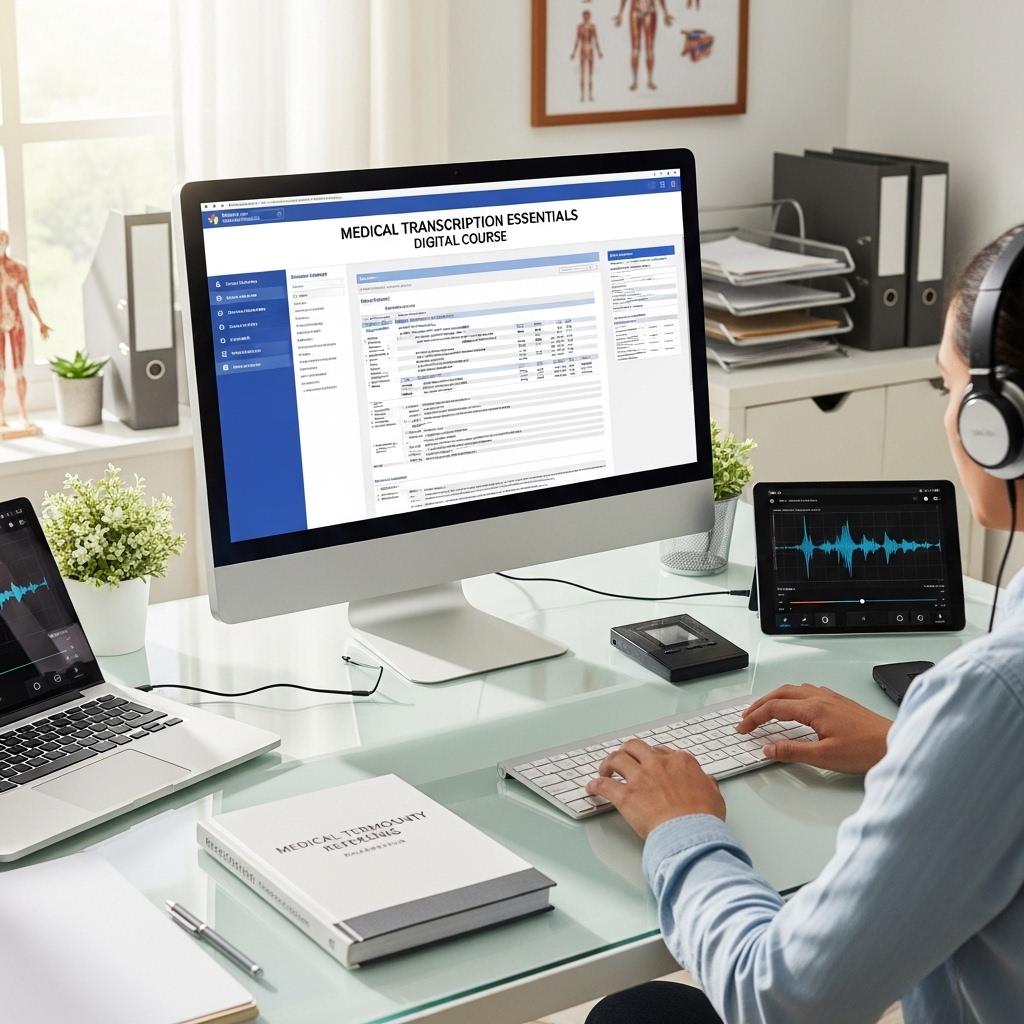

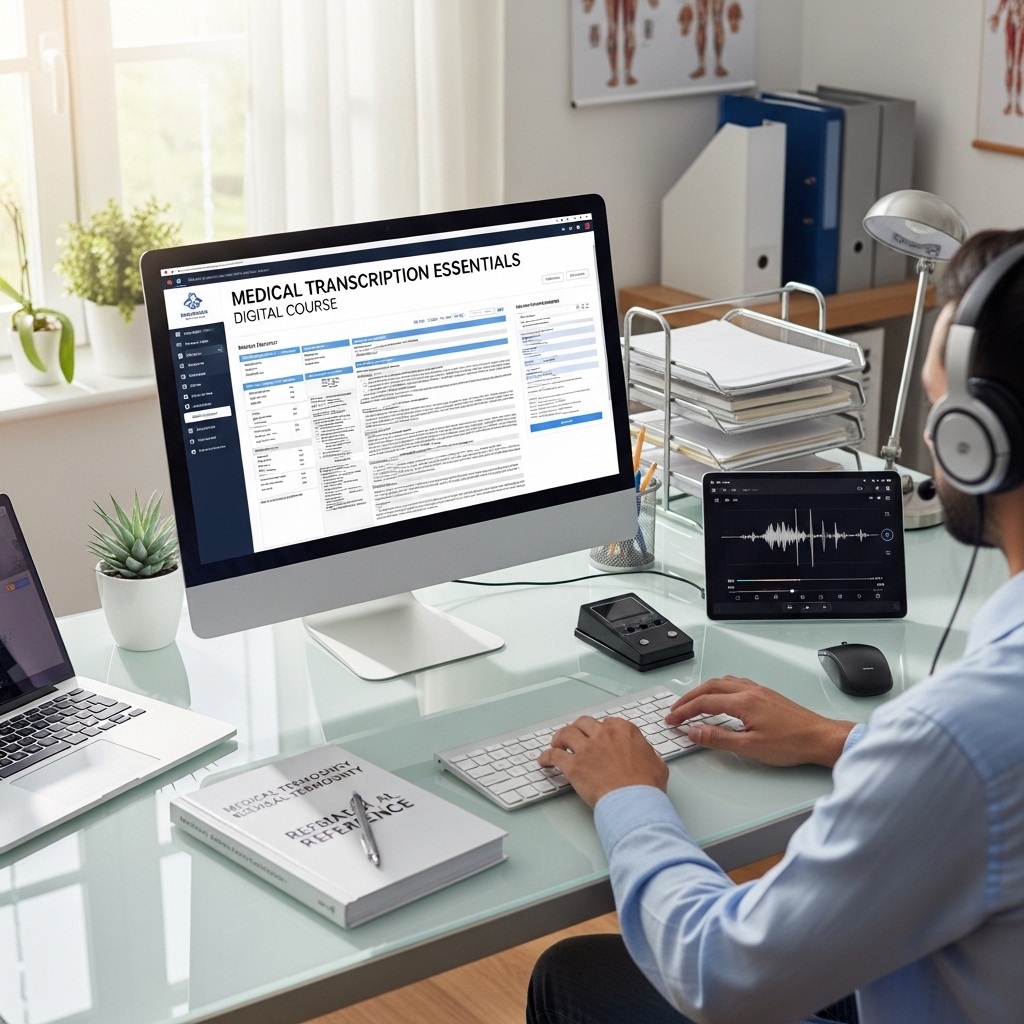
Medical Transcription Essentials Digital Course
🏥 Medical Language Is a Precision Instrument. Transcribing It Requires the Same Precision.
Every medical transcription error carries a weight that errors in other transcription domains do not. A misspelled medication name in a deposition transcript is a professional embarrassment. A misspelled medication name in a clinical record is a patient safety issue. A diagnosis term rendered with a single incorrect prefix changes the meaning entirely, from a malignant condition to a benign one, from a chronic condition to an acute one, from one organ system to another. The margin for error in medical transcription is not the same as in other transcription domains, and the knowledge base required to consistently produce accurate medical transcripts is both broader and deeper than many aspiring medical transcriptionists initially appreciate.
Medical transcription requires fluency in four overlapping language systems simultaneously: the anatomical nomenclature of the body’s structures, the pathophysiological language of disease processes and conditions, the pharmacological vocabulary of medications and their drug classes, and the procedural vocabulary of surgical, diagnostic, and therapeutic interventions. Across all four systems, the practitioner needs not just recognition (knowing the term when they hear it) but production-level fluency (knowing the correct spelling, hyphenation, capitalization, and abbreviation conventions the moment the dictation reaches them).
The Medical Transcription Essentials Digital Course is a rigorous, professionally developed digital learning program covering the complete knowledge base required for competent medical transcription practice, from anatomical systems through specialty terminology, pharmacology, procedural vocabulary, report formatting standards, and quality assurance.
📦 Complete Course Package
Digital-only. Instant access. Everything included:
Core Course Curriculum (.pdf, 10 modules, 220 pages)
Module 1: Medical Language Foundations (18 pages) — Word parts (prefixes, suffixes, combining forms), pronunciation guide for medical vocabulary, abbreviation standards and context-specific abbreviation caution, and metric/measurement systems in medical documentation.
Module 2: Anatomy and Physiology for Transcriptionists (28 pages) — System-by-system anatomical vocabulary covering musculoskeletal, cardiovascular, respiratory, gastrointestinal, neurological, endocrine, genitourinary, and integumentary systems, with specific attention to the terminology most frequently encountered in medical dictation.
Module 3: Pathology and Disease Terminology (22 pages) — Disease nomenclature, diagnostic terminology, condition classification vocabulary, cancer staging vocabulary, and the vocabulary of symptom description.
Module 4: Pharmacology for Medical Transcriptionists (20 pages) — Drug class terminology, generic vs. brand name handling standards, route-of-administration terminology, dosage notation conventions, and a structured approach to researching unfamiliar medication names.
Module 5: Medical and Surgical Procedures (22 pages) — Surgical procedure vocabulary by specialty (general surgery, orthopedic, cardiovascular, neurosurgical, gynecological), diagnostic procedure vocabulary (imaging, laboratory, endoscopic), and therapeutic procedure vocabulary.
Module 6: Medical Specialty Terminology Tracks (30 pages) — Dedicated terminology sections for seven high-demand specialties: cardiology, orthopedics, neurology, oncology, obstetrics and gynecology, radiology, and psychiatric medicine.
Module 7: Medical Report Types and Formatting Standards (24 pages) — History and Physical (H&P) format, operative report format, discharge summary format, radiology report format, consultation report format, SOAP note format, and the AHDI (Association for Healthcare Documentation Integrity) formatting standards reference.
Module 8: Quality Standards and Error Prevention (18 pages) — AHDI quality standards, flagging protocol for unclear dictation, critical value and patient safety flag procedures, research methodology for uncertain terms, and self-audit practices for medical transcriptionists.
Module 9: Technology and Tools for Medical Transcriptionists (16 pages) — Transcription software and foot pedal configuration, medical spell-check customization, reference database use (Stedman’s, Dorland’s, Drug Facts and Comparisons), electronic health record system transcription integration, and speech recognition software correction workflow.
Module 10: Professional Practice and Career Development (22 pages) — HIPAA compliance for medical transcriptionists, data handling and security obligations, professional certification (RHDS, CHDS) pathways, remote work setup for medical transcription, and continuing education resources.
Medical Terminology Mastery Workbooks (.pdf, 3 workbooks) Three structured practice workbooks:
- Terminology Recognition Drills: 600 fill-in and matching exercises covering all major terminology categories from the curriculum
- Dictation Context Exercises: 80 authentic-style dictation passage excerpts with blanks for difficult terms, answer keys, and usage notes
- Spelling and Hyphenation Precision Exercises: 300 targeted spelling and notation exercises for the most commonly misspelled medical terms
Quick-Reference Terminology Card Set (.pdf, printable) Eight printable reference cards covering: anatomical directional terms, common prefixes and suffixes, surgical suffix reference, abbreviation reference (with caution-flagged ambiguous abbreviations), common medications by class, laboratory value reference, vital signs normal range reference, and medical specialty common terms.
Certification Preparation Guide (.pdf, 18 pages) RHDS and CHDS examination preparation covering: examination content outline alignment, study priority mapping, practice question sets by content area, and examination day preparation.
📂 What Downloads to Your Device
📚 Core Curriculum (.pdf, 10 modules, 220 pages) — Complete medical transcription knowledge base from foundations through professional practice 📝 Terminology Mastery Workbooks (.pdf, 3 volumes) — 600 terminology drills, 80 dictation context exercises, and 300 spelling precision exercises 🗂️ Quick-Reference Card Set (.pdf) — 8 printable specialty reference cards for daily practice use 🎓 Certification Preparation Guide (.pdf, 18 pages) — RHDS and CHDS examination alignment and study planning

Reviews
There are no reviews yet.