

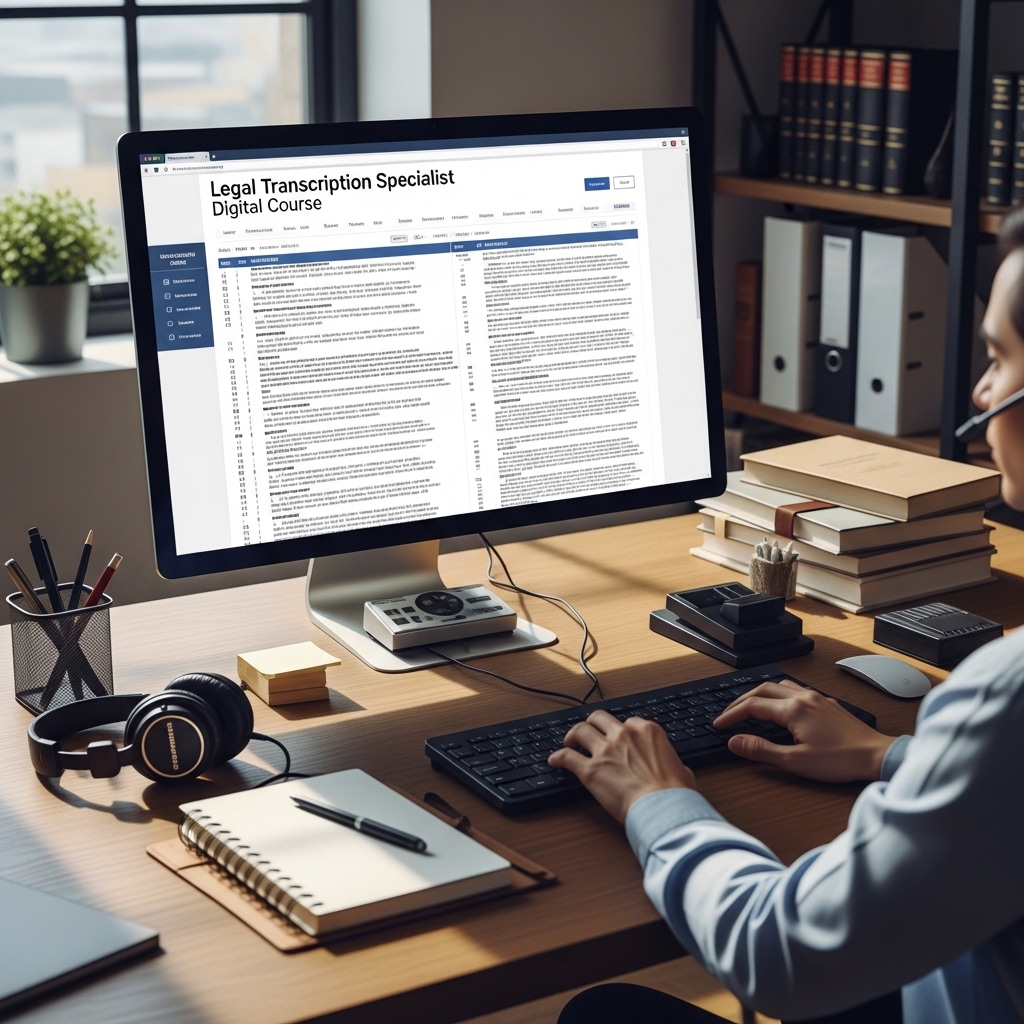

Legal Transcription Specialist Digital Course
⚖️ Legal Proceedings Demand a Transcriptionist Who Understands What They’re Transcribing
There is a meaningful professional difference between a transcriptionist who can render speech accurately and one who can render legal proceedings accurately. A general transcriptionist who is fast and accurate can produce a technically faithful reproduction of what was said. A legal transcription specialist does this and more: they understand the procedural context well enough to format a deposition transcript correctly, to apply the right notation when an attorney makes an objection and the witness continues speaking, to render the legal terminology with the precision that a transcript filed as a legal record requires, to handle the formatting conventions of exhibits and stipulations correctly, and to produce a transcript that meets the specific certification and formatting standards of the jurisdiction where the proceeding occurred.
This contextual knowledge is not ancillary to legal transcription. It is what distinguishes a transcript that can be filed, cited, and relied upon from one that requires significant post-production correction before it is fit for purpose. And it is knowledge that cannot be picked up incidentally from doing the work without structured instruction: the precise scenarios where specific legal vocabulary applies, the formatting rules that govern different proceeding types, the certification requirements that vary by state and court level, and the specific error types that create legal liability in transcript records.
The Legal Transcription Specialist Digital Course is the most comprehensive digital training program available for transcriptionists who want to develop genuine, deep competency in legal transcription, covering legal procedure, legal terminology, transcript formatting, jurisdiction-specific requirements, certification standards, and professional practice in the legal services industry.
📦 Complete Course Package Contents
100% digital. Nothing physical ships. Instant download:
Core Course Curriculum (.pdf, 12 modules, 250+ pages)
Module 1: The Legal System and Proceedings Structure (20 pages) How the U.S. legal system is organized and how different proceeding types generate transcription work. Covers: federal vs. state court system structure, civil vs. criminal proceeding distinction, the stages of civil litigation where transcription is required (discovery phase, deposition, motion hearing, trial), arbitration and administrative proceeding transcription, the role of the court reporter and the transcript in the legal record, and how transcriptionist work interfaces with the broader legal services ecosystem.
Module 2: Legal Terminology Mastery (28 pages) The vocabulary of legal practice with the depth required for transcription accuracy. Covers: Latin legal terms and their precise meanings and usage contexts, civil procedure terminology (pleadings, motions, discovery, pre-trial and trial stages), evidence law terminology (objection grounds, ruling vocabulary, witness examination vocabulary), substantive law areas vocabulary (contract, tort, property, family, criminal), and court officer and participant identification vocabulary. Includes a 400-term legal reference glossary.
Module 3: Deposition Transcript Formatting Standards (24 pages) The complete formatting standards for deposition transcripts, the most common legal transcription deliverable. Covers: caption page requirements (all required fields and their sources), standard page and line numbering requirements, Q and A format (with every variation: question without answer, answer without question, interrupted question, interrupted answer), speaker and examination designation standards (direct, cross, redirect, recross, examination by the court), objection notation (complete objection preservation, instruction-to-witness notation, ruling notation), colloquy and off-the-record notation standards, exhibit marking notation, stipulation documentation, index page requirements, and certification block language and requirements.
Module 4: Court Proceeding Transcript Formatting (20 pages) Formatting standards for in-court proceedings including: appearances notation, judicial officer identification, courtroom personnel identification, opening statement notation, jury instruction formatting, verdict and sentence documentation, and the specific formatting differences between trial court, appellate, and administrative hearing transcripts.
Module 5: Jurisdiction-Specific Requirements (22 pages) How transcript formatting requirements, certification language, and delivery standards vary across jurisdictions. Covers: the landscape of state-level court reporter certification requirements, common variations in certification block language, page and line numbering format variations, signature page requirements, how to research jurisdiction-specific requirements for an unfamiliar state, and federal court transcript requirements.
Module 6: Legal Objections and Rulings Transcription (18 pages) A dedicated module on the most technically complex and legally significant component of deposition and court transcription. Covers: the complete vocabulary of legal objections (relevance, hearsay and its exceptions, foundation, speculation, form objections, privilege objections, and more), how to transcribe an objection that is followed by a ruling, how to transcribe an objection that is followed by instruction not to answer, how to handle simultaneous speech during an objection sequence, and the specific transcription consequences of incomplete objection preservation.
Module 7: Expert Witness Testimony Transcription (16 pages) The specific challenges of expert witness transcription. Covers: technical and scientific vocabulary across common expert witness domains (accident reconstruction, forensic accounting, medical, engineering, economic), credential and qualification notation, demonstrative exhibit reference notation, and research methodology for domain-specific technical terminology.
Module 8: Deposition Exhibits and Attachments (14 pages) How exhibits are introduced, marked, and documented in deposition transcripts. Covers: exhibit marking notation, exhibit introduction procedure transcription, exhibit reference notation during testimony, exhibit index formatting, and handling exhibits that are not physically marked but are referenced by description.
Module 9: Legal Ethics and Confidentiality for Transcriptionists (12 pages) The professional ethics obligations relevant to legal transcription practice. Covers: confidentiality obligations, work product doctrine implications, unauthorized practice of law boundary, handling transcript correction requests, chain of custody considerations for transcript records, and data security obligations for legal transcription work.
Module 10: Technology and Workflow for Legal Transcriptionists (16 pages) The tools and workflow of professional legal transcription practice. Covers: transcription software options for legal work, legal terminology spell-check customization, templates setup for common transcript formats, file naming and version control for legal deliverables, secure file transfer for legal materials, and legal reference database use (Westlaw, Black’s Law Dictionary, court rules databases).
Module 11: Quality Assurance for Legal Transcripts (18 pages) The specific quality assurance requirements of legal transcript production. Covers: legal transcript review methodology, certification language verification, speaker attribution verification, objection completeness audit, exhibit notation audit, and the specific consequences of quality failures in legal transcript records.
Module 12: Professional Practice in Legal Services (22 pages) Building and managing a legal transcription practice. Covers: the legal transcription market landscape (court reporting agencies, law firm direct clients, legal staffing platforms), rate structures in legal transcription, professional certification for legal transcriptionists, continuing education requirements, and professional association resources.
Legal Formatting Practice Workbook (.pdf, 60 structured exercises) Sixty formatting exercises progressing from basic to complex: basic Q&A formatting, objection sequence formatting, multi-party examination, exhibit introduction, colloquy and off-the-record sequences, certification block completion, and full short-transcript formatting exercises from raw text to finished format.
Legal Terminology Reference Library (.pdf, 4 specialized references) Four comprehensive reference documents:
- Legal Glossary (400 terms): Complete legal vocabulary reference with definitions, usage context, and common misspellings
- Latin Legal Terms Reference (120 terms): Commonly encountered Latin legal terms with pronunciation guide, definition, and transcription context
- Objection Vocabulary Reference: Complete objection grounds vocabulary with definitional explanations for transcription context understanding
- Legal Abbreviation Reference: Court-accepted abbreviations with context guidance
State Certification Requirements Summary (.pdf, nationwide reference) A 50-state reference document summarizing court reporter certification requirements, certification body contacts, and transcript formatting notes for all 50 states plus federal courts. Organized for quick reference during jurisdiction research.
Certification Preparation Pack (.pdf) Preparation materials aligned to the Registered Professional Reporter (RPR) written knowledge examination and the Certified Legal Transcriptionist credential pathways: content outline mapping, subject area practice question banks, and examination strategy guidance.
📂 What Downloads to Your Device
📚 Core Course Curriculum (.pdf, 12 modules, 250+ pages) — Complete legal transcription specialist training from procedure through professional practice ✏️ Legal Formatting Practice Workbook (.pdf) — 60 structured exercises from basic formatting through full transcript production 📖 Legal Terminology Reference Library (.pdf, 4 references) — 400-term glossary, 120 Latin terms, complete objection vocabulary, and abbreviation guide 🗺️ State Certification Requirements Summary (.pdf) — 50-state and federal court formatting and certification quick reference 🎓 Certification Preparation Pack (.pdf) — RPR and CLT credential pathway alignment, practice questions, and examination strategy

Reviews
There are no reviews yet.