
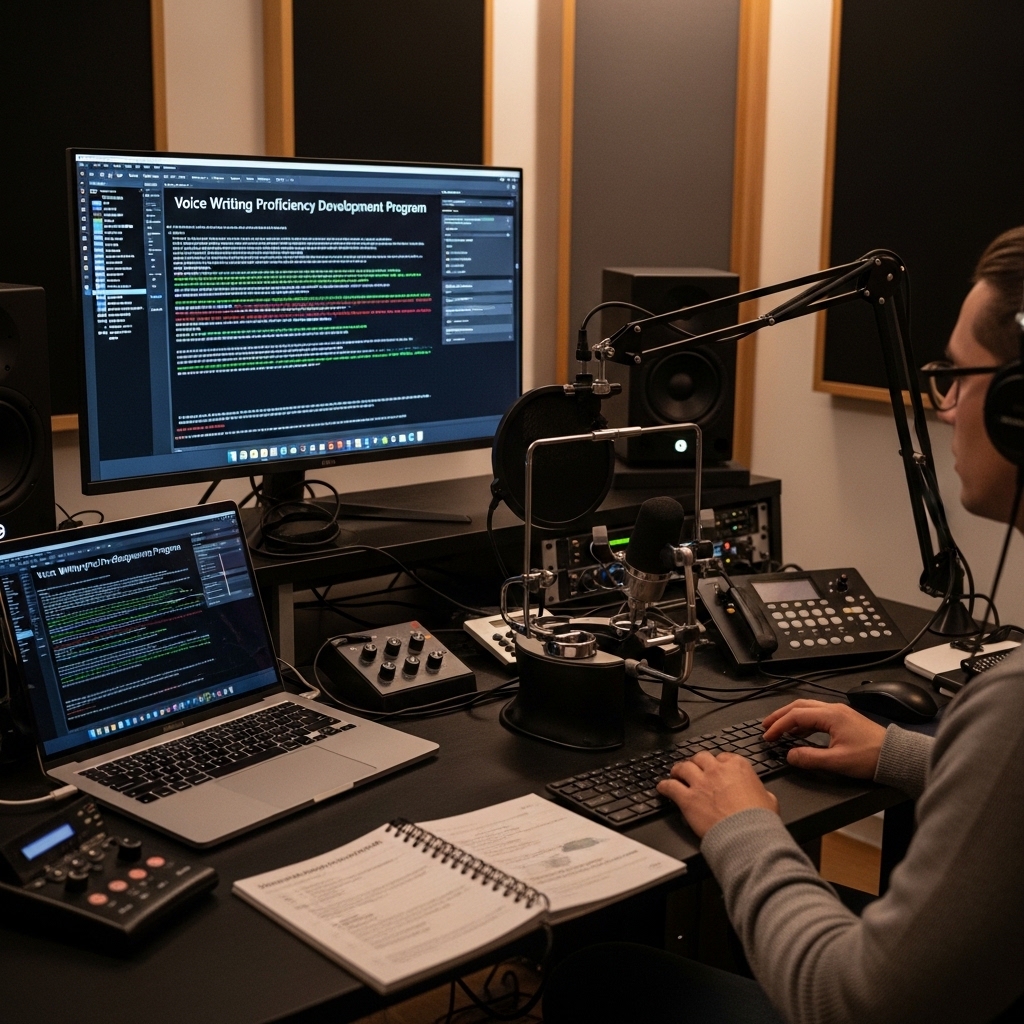
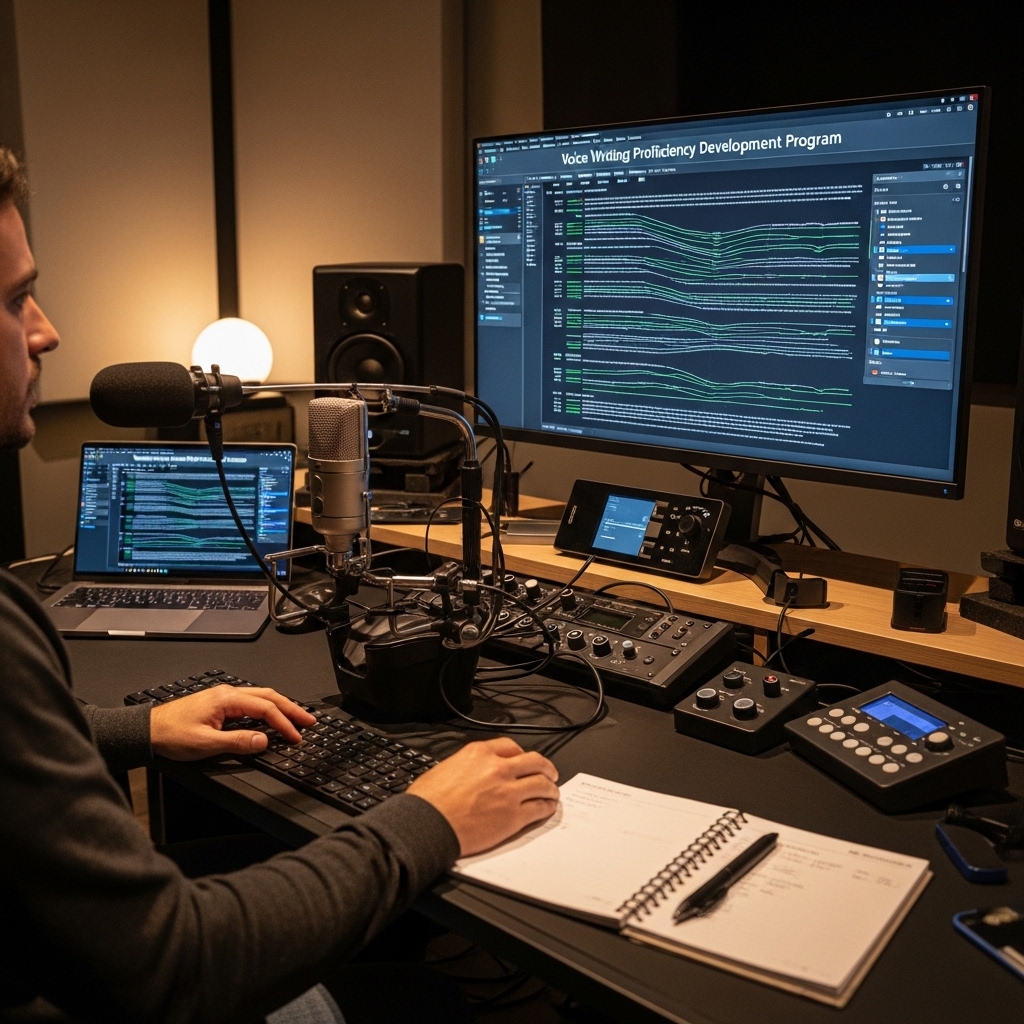
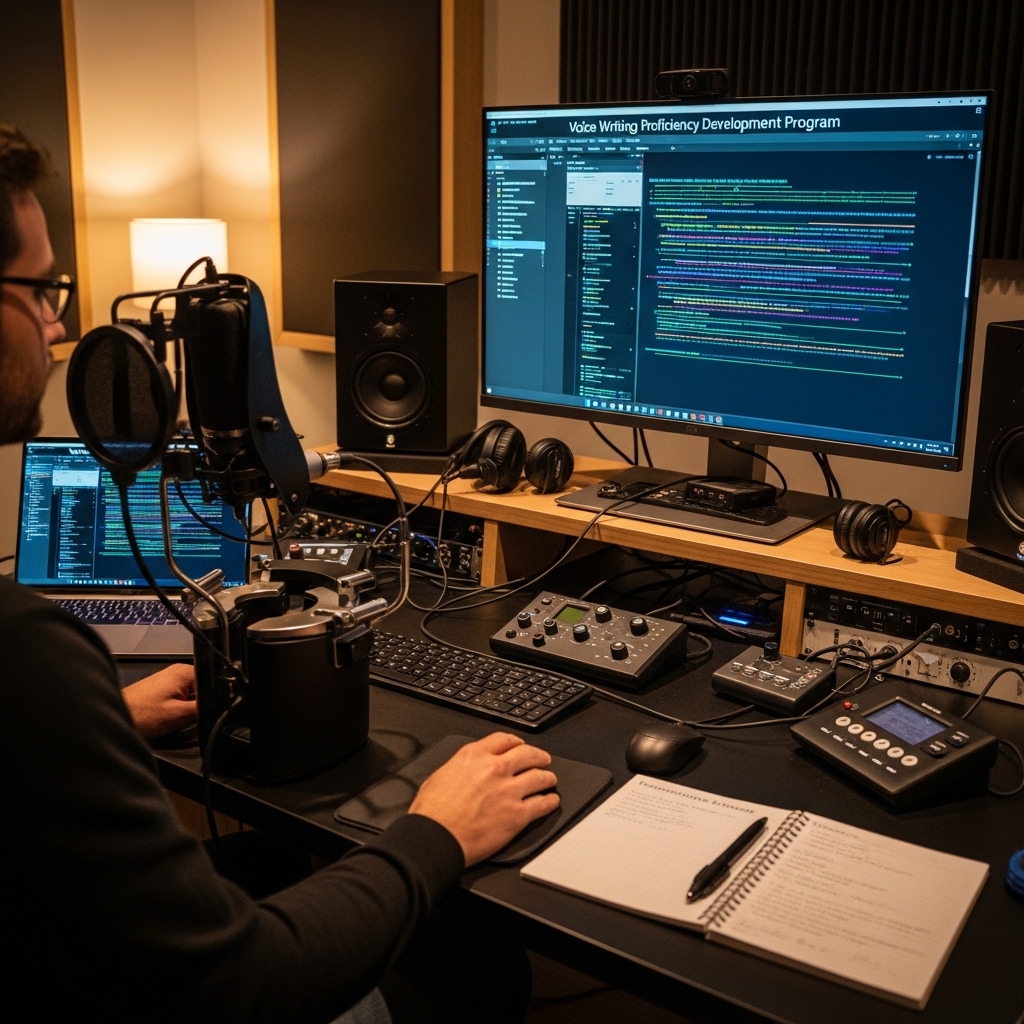
Voice Writing Proficiency Development Program
🎤 Voice Writing Is a Distinct Craft. Developing It Systematically Produces Results That Practice Alone Rarely Does.
Voice writing occupies a fascinating and sometimes misunderstood position in the stenographic profession. It is often perceived as the “easier” alternative to machine stenography, primarily by people who have never done it at the professional level required for legal, broadcast, or CART work. In reality, voice writing at professional production accuracy requires the same core competencies that define excellence in any stenographic modality: a trained ear that processes speech before the conscious mind catches up, a voice and delivery system calibrated for the specific output requirements of the job, a vocabulary preparation and research discipline that minimizes first-pass errors, and a continuous professional development practice that identifies and addresses personal accuracy gaps systematically.
What voice writing requires differently from machine stenography is a distinct set of physical and vocal skills (breath control, articulation precision, voice mask technique, microphone management), a different relationship with preparation materials (phonetic rendering must be anticipated and practiced before the proceeding, not addressed through dictionary loading), and a specific kind of self-monitoring discipline that allows a voice writer to track both the speaker and their own output simultaneously.
The Voice Writing Proficiency Development Program is the most structured, comprehensive digital training program available for voice writers at every stage of development, from students preparing for their first professional assignment through experienced voice writers who want to close specific accuracy gaps and expand into new practice areas.
📦 Complete Program Contents
Digital-only product. Nothing physical ships. Your program includes:
Core Development Curriculum (.pdf, 8 modules, 180 pages)
Module 1: Voice Writing Mechanics and Physiology (18 pages) The physical foundation of voice writing proficiency. Topics: respiratory mechanics for sustained voice writing (how breath control affects articulation accuracy), voice mask technique and proper seal for different microphone systems, articulation precision for machine-readable output (the specific phoneme clarity requirements of voice recognition software), fatigue management (vocal and cognitive), microphone selection and positioning for different job environments, and voice hygiene practices for professionals who speak for extended periods.
Module 2: Software Calibration and Recognition Optimization (20 pages) Maximizing the accuracy of your voice recognition system. Topics: acoustic model training methodology, user profile calibration for different recording environments, custom vocabulary loading strategy, correction command efficiency (correcting without breaking production flow), speaker-independent vs. speaker-dependent system trade-offs, and system performance monitoring and recalibration.
Module 3: Vocabulary and Terminology Preparation (22 pages) The preparation discipline that separates professionals who consistently achieve high accuracy from those who rely on post-production correction. Topics: subject matter research protocol before a proceeding, phonetic rendering practice methodology (how to practice rendering a technical term accurately before you encounter it live), proper noun preparation (name pronunciation research, phonetic representation in practice material), and domain vocabulary libraries for legal, medical, and technical subject matters.
Module 4: Legal Voice Writing Development Track (24 pages) Specialized skills for legal deposition and court proceeding voice writing. Topics: legal terminology fluency development, objection notation methodology (capturing objection language, ruling, and instruction accurately at real-time speed), multi-party speaker identification technique, sidebar and off-the-record notation standards, exhibit marking notation, and the specific voice writing techniques for keeping pace with rapid-fire legal examination sequences.
Module 5: CART and Accessibility Voice Writing (20 pages) Voice writing specifically for communication access real-time translation provision. Topics: display output formatting for CART (paragraph breaks, speaker labels, punctuation for accessibility), consumer reading speed awareness and output pacing, academic lecture voice writing technique (capturing lecture content, board references, student questions), and consumer-preference-responsive output adjustment.
Module 6: Broadcast and Media Voice Writing (18 pages) Voice writing for broadcast captioning environments. Topics: program monitoring while producing output, managing rapid pace and content switches in broadcast, handling unexpected content (breaking news, unscripted moments), music and sound effect notation in voice writing workflow, and offline voice writing technique for recorded content captioning.
Module 7: Accuracy Analysis and Targeted Development (22 pages) Using output analysis to build a targeted improvement practice. Topics: error categorization for voice writers (recognition error vs. articulation error vs. vocabulary error vs. monitoring failure), output review methodology for self-assessment, accuracy rate calculation, targeted drill design for specific error categories, and professional development benchmarking.
Module 8: Certification Preparation for Voice Writers (16 pages) Preparation specifically for the NVRA (National Verbatim Reporters Association) certification examinations, covering: examination format and requirements, speed building for examination passages, accuracy standards and common examination failure patterns, testing environment preparation, and post-examination professional development.
Speed and Accuracy Development Drill Library (.pdf, 120 practice passages) One hundred twenty structured practice passages organized by:
- Speed level (120, 140, 160, 180, 200, 225, and 250+ WPM tiers)
- Content category (legal examination Q&A, medical testimony, technical expert testimony, narrative, multi-party dialogue, broadcast-style news, academic lecture)
- Vocabulary density (standard vocabulary, legal-dense, medical-dense, technical-dense)
Each passage includes: the practice text, a terminology reference for pre-practice preparation, a challenging vocabulary highlight list, and notes on the specific voice writing skills the passage develops.
Voice Writing Self-Assessment Scoring System (.xlsx) A structured accuracy tracking and development planning tool: log practice session results by passage, speed, and accuracy rate, track accuracy trends by content category, identify speed ceiling and accuracy floor intersections, and auto-generate a prioritized development plan based on your performance profile.
📂 What Downloads to Your Device
📚 Core Development Curriculum (.pdf, 8 modules, 180 pages) — Complete voice writing proficiency training from mechanics through specialty practice 🎙️ Speed and Accuracy Drill Library (.pdf) — 120 structured practice passages across speed tiers, content categories, and vocabulary densities 📊 Self-Assessment Scoring System (.xlsx) — Session tracking, accuracy trending, and targeted development planning

Reviews
There are no reviews yet.